Dispatch: Context #1 - A New AI-Focused Series


GM Friends. This is JetpackCompose.app's Dispatch, kicking off 2026 with something I've been thinking about for a while now.
Today I'm announcing Dispatch: Context, a new series of dedicated AI-focused issues that will be sprinkled between your regular Dispatch editions.
📣 Introducing Dispatch: Context
If you've been reading Dispatch for a while, you've noticed AI topics creeping in more frequently. That wasn't accidental. It's where my head has been over the last ~4 years, and increasingly, it's where yours needs to be too.
Dispatch: Context is my attempt to go deeper with you all.
The name is intentional. "Context" means something to every Android developer. It's one of the first classes you learn, one of the most fundamental (and occasionally frustrating) parts of the SDK. But in the AI world, context is everything too: context windows, context length, giving the model enough context to be useful.
And at its core, that's what this series will do: give you the context you need to navigate this shift.
What to expect:
- Dedicated issues focused entirely on AI: tools, workflows, mental models, career implications
- Practical, opinionated takes (not hype, not doom)
- Written for Android/mobile engineers specifically, not generic "AI for devs" content
- The same voice you're used to, just a different lens
Your regular Dispatch issues aren't going anywhere. Think of Dispatch: Context as a companion series, one that I hope helps you stay ahead of the curve instead of scrambling to catch up.
Now let me tell you why I'm doing this, and why now.
The "Vibes" Have Shifted Dramatically
Hopefully you are starting to realize that this is going to be a really important (and very different) "back to work" month for you. Especially if you and your team isn't yet operating with AI-native tooling and workflows.
In the past couple weeks, no new models dropped. No massive feature launches. And yet… the vibes have clearly shifted.
People had downtime over the Christmas break. They reflected on how much their day-to-day work changed over the past year. And when they shared those reflections publicly, it resonated hard. If you were even casually active on LinkedIn or Twitter, you probably felt it too.
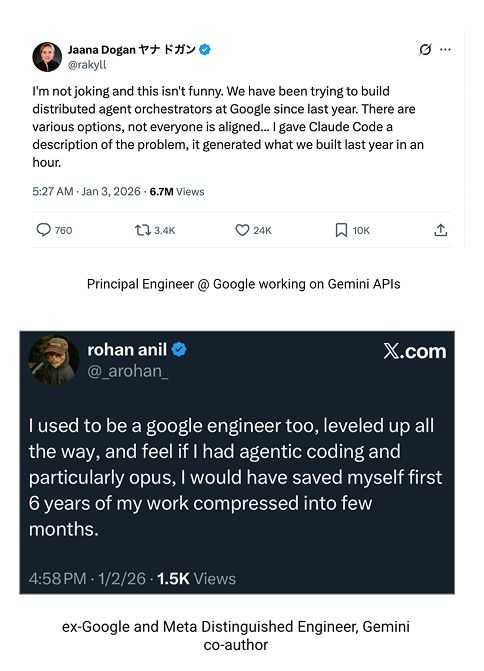 Even the pioneers of the field are feeling behind. The goal of this newsletter has always been to only give you the information you need so that you don't feel overwhelmed. That's my commitment to you.
 Even Linus Trovalds (who hates 99.999% of people and things) just came around to the idea of using AI for writing code last week
There's a growing, quiet realization: the work itself has changed, not just the tools around it.
Other people I really admire, like my friend Kaushik Gopal are realizing this too. Every engineer, irrespective of what niche they might've historically felt passionately about, needs to embrace AI Engineering. It would be foolish not too. The writing is on the wall. You owe it to yourself to be world class at it.
Your Job in 2026 and beyond
If you don't yet have a Professional Ikigai for 2026, let me offer one: make this the year you deliberately invest a few focused hours a week embracing "Agentic AI". Without cynicism, defensiveness, or doom-scrolling.
Your job as an engineer in 2026 isn't to "adopt AI tools."
It's to:
- Redesign workflows around what's now possible
- Update what "good" and "excellent" look like for your craft
- Aggressively eliminate work that no longer makes sense to do by hand
That shift is uncomfortable at first. But I'm confident most of you will end up having more fun.
And just so I'm direct about what I mean here: if you are simply using chat-based AI tools like ChatGPT, you are still going to be treated as a dinosaur. The bar raised consistently throughout 2025, and you will be left behind if you aren't constantly updating your skills.
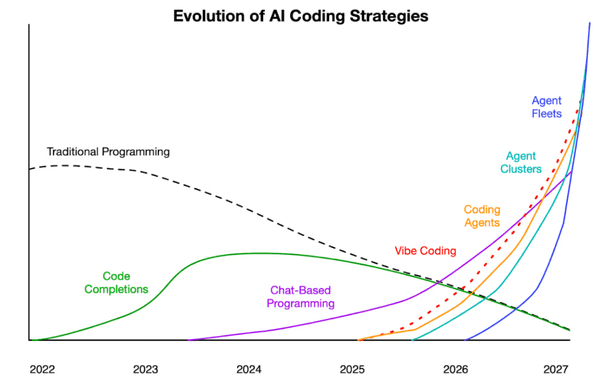 If you are restricting yourself to just chat based tools like ChatGPT, you will be treated as a dinosaur as your ceiling will be much lower than what the other paradigms already enable. The ICs understand this well but this is a big gap in engineering leaders and Staff+ ICs who aren't coding as often and don't understand the value of still using these agents for other aspects of the SDLC.
Learn how to be world-class when using AI native tools like Firebender and Claude Code. The conversations I'm seeing, the ones that are resonating, are specifically about workflows that embrace Agentic AI. Not just "I asked ChatGPT a question."
Why Listen to Me
Look, I know everyone and their grandma has opinions about AI. So why should you listen to me?
I've spent the first 14 years of my career building Android apps. I know this ecosystem deeply: the pain points, the patterns, the way we work. I'm not some AI evangelist parachuting in from a different world.
But here's the other half: in 2023, I helped kickstart the AI-for-developer-productivity effort at Airbnb. We were early, and we were right. For four consecutive halves, the work my team shipped was the top-voted improvement across all developer tooling at the company. Not just mobile — all of engineering.
That track record is what set me up for my current role: leading AI DevTools across Databricks. I was able to seamlessly transition into a role with more scope, at a company that's at the bleeding edge of AI infrastructure.
What this means for you: I'm exposed to problems, challenges, and technology that most people simply aren't. I'm not theorizing about what's coming. I'm helping shape it. In fact, my job is to be obsessed about this, filter out all the noise and focus on things that will move the needle for a few thousand engineers. And I want to share what I'm learning with my people — this community that I've enjoyed talking to over the past few years through JetpackCompose.app and it's newsletter.
Why I Care So Much About This
I've been thinking about how much life has changed in the four years since Copilot launched. Our day-to-day as engineers looks completely different. And yet, I see a lot of pessimism among Android engineers specifically.
I genuinely believe this is a grave mistake 🪦
Pessimists avoid risk. Optimists change the world.
And there is no better time to be an optimist than right now.
On one side, you hear about the job market being absolutely brutal. On the other side, you hear about $100 million offers to top AI researchers. This dichotomy isn't random. It's the market aggressively repricing talent based on relevance to the new paradigm.
This is going to be a dinosaurs-going-extinct moment if you don't adapt. If you don't learn. If you're not on the cutting edge.
I myself interviewed after six years earlier in the year, and my experience was very different compared to how bleak the market might sound. You'd be surprised at how much value can be generated for the right candidates. The onus is on you to stand out.
Here's another factor: it's especially easy to stand out when things are new. When nothing is established yet. When you're at ground level.
I've done this a few times in my career. Jetpack Compose was one example. I was super early, when the project was still in dev-preview (even before alpha). I used it to meaningfully accelerate my career: promotions, speaking opportunities, open source recognition, the works. There's often a small window to catch these waves, and then it closes.
I feel passionately about this community. I want you to be obsessed with this shift.
But here's the thing I really want you to understand: this isn't just about survival or career insurance. I'm not writing this from a place of fear. I'm writing this because I'm genuinely having the time of my life.
Almost every day, I experience this feeling of "holy shit, I can't believe that just worked." The craft of building software feels new again. Problems that used to take hours now take minutes. Ideas that I'd shelve because "that would take too long" are suddenly within reach. It's the most fun I've had programming in years.
I want each and everyone of you to feel that — EVERY SINGLE DAY.
This isn't about being an AI fanboy or doom-pilled doomer. This is about seeing how something is positively impacting your day-to-day and being foolish to ignore it.
What's Next
Dispatch: Context issues will start rolling out over the coming weeks. I'll be covering:
- How to actually get started with agentic AI tools (practical, step-by-step)
- What workflows are changing and how to adapt yours
- The mental models that separate "using AI" from "working with AI"
- How to evaluate which tools are worth your time
- Career implications and how to position yourself
If there are specific topics you want me to cover, reply to this email. I read everything.
🤝 The Honor Code
I've been creating content for the Android community for over a decade now. Talks, Articles, Open-source projects like Showkase, this newsletter, JetpackCompose.app. I've never charged a penny for any of it.
But here's the deal.
If you've read more than one article that helped you. If you've had more than one "aha" moment from something I wrote or shared. If Dispatch has ever made you smarter at your job or helped you learn about something new.
Then I expect you to share this.
Not asking. Expecting. That's the honor code 🤝
Tweet it. Bluesky it. Send it to your team's Slack. Forward this email to that one Android friend who needs to read this. Whatever works.
The future is already here. Let's make sure you're in it.


